
Are you struggling to rank your website on Google? You’re not alone. Thousands of website owners spend money on SEO without understanding what actually moves the needle in search engine rankings.
The truth is, SEO has evolved significantly over the past few years. Google’s algorithms have become smarter, and what worked in 2020 might not work in 2024. This comprehensive guide reveals the 10 most critical SEO ranking factors that will genuinely improve your website’s visibility in search results.
Whether you’re a business owner, marketer, or content creator, understanding these factors is essential for your online success.
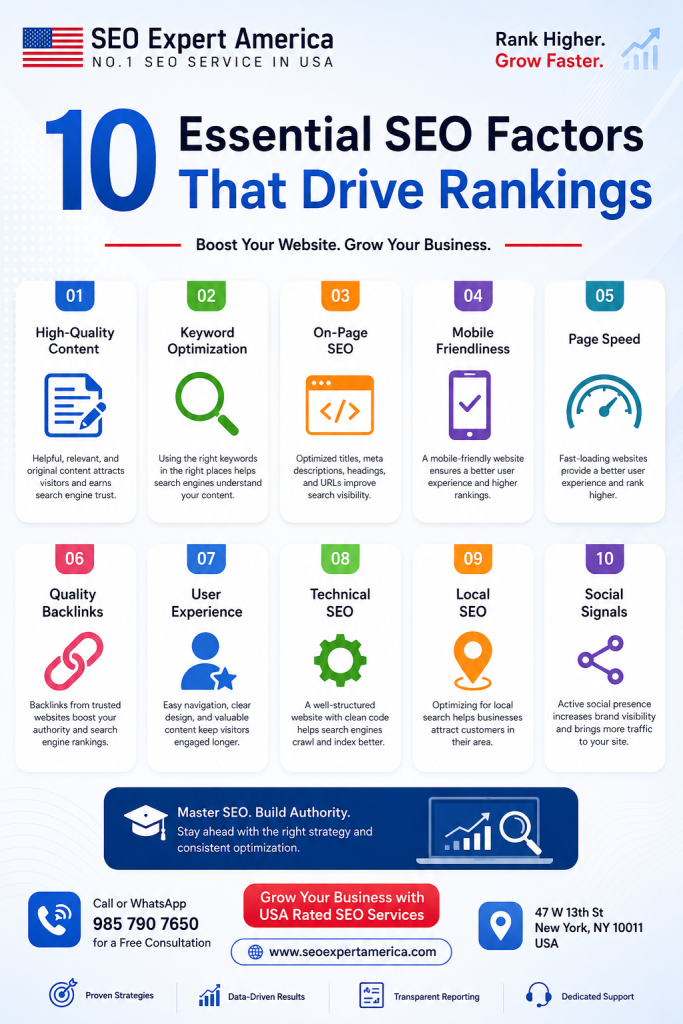
1. High-Quality, Relevant Content
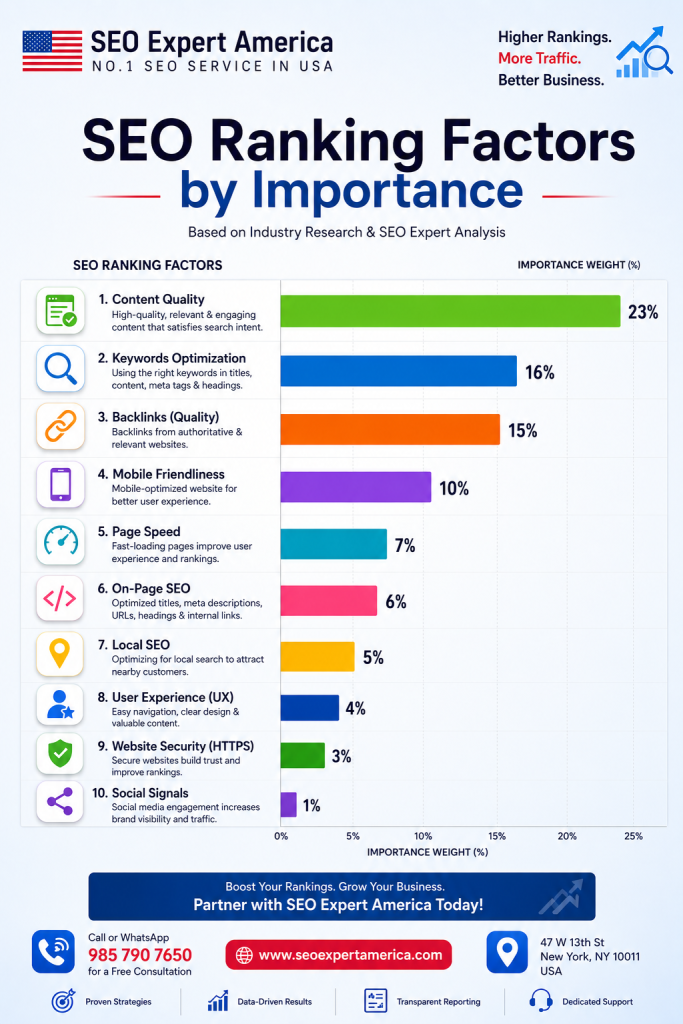
Content is still king in the world of SEO. Google prioritizes websites that provide valuable, comprehensive information to users.
What This Means:
- Write content that’s at least 1,500-2,000 words for competitive keywords
- Answer user questions thoroughly and comprehensively
- Include data, statistics, and real-world examples
- Use natural language and avoid keyword stuffing
- Update old content regularly to keep it fresh
Why It Matters:
Google uses sophisticated AI to understand content quality. Websites with in-depth, well-researched content consistently outrank thin, superficial pages.
2. Backlinks (Links from Other Websites)
Backlinks remain one of the strongest ranking signals. A link from another website to yours acts like a “vote of confidence” in Google’s eyes.
What This Means:
- Focus on acquiring links from authoritative, relevant websites
- One link from a high-authority site is worth more than 100 from low-quality sites
- Guest posting on reputable blogs in your industry
- Create link-worthy content that naturally attracts links
- Avoid buying links or participating in link schemes
Why It Matters:
Google views your website’s trustworthiness and authority through the lens of who links to you. Quality backlinks from respected sources signal credibility to search engines.
3. Page Speed and Core Web Vitals
User experience has become a major ranking factor. Google measures how quickly your pages load and how smoothly users interact with them.
What This Means:
- Optimize images to reduce file sizes
- Minimize CSS and JavaScript code
- Use a Content Delivery Network (CDN)
- Enable browser caching
- Choose reliable hosting
- Monitor Largest Contentful Paint (LCP), Cumulative Layout Shift (CLS), and First Input Delay (FID)
Why It Matters:
Slow websites frustrate users, leading to higher bounce rates. Google wants to rank sites that provide excellent user experiences, which includes fast loading times.
4. Mobile-Friendliness
Over 60% of searches now happen on mobile devices. Google prioritizes mobile-friendly websites because most of their users browse on smartphones.
What This Means:
- Use responsive design that adapts to all screen sizes
- Ensure buttons and links are easy to tap on mobile
- Avoid intrusive pop-ups on mobile devices
- Test your website on various devices
- Use Google’s Mobile-Friendly Test tool
Why It Matters:
If your site isn’t mobile-friendly, you’re losing potential customers. Google actively penalizes non-responsive websites in mobile search results.
5. Meta Tags and On-Page SEO
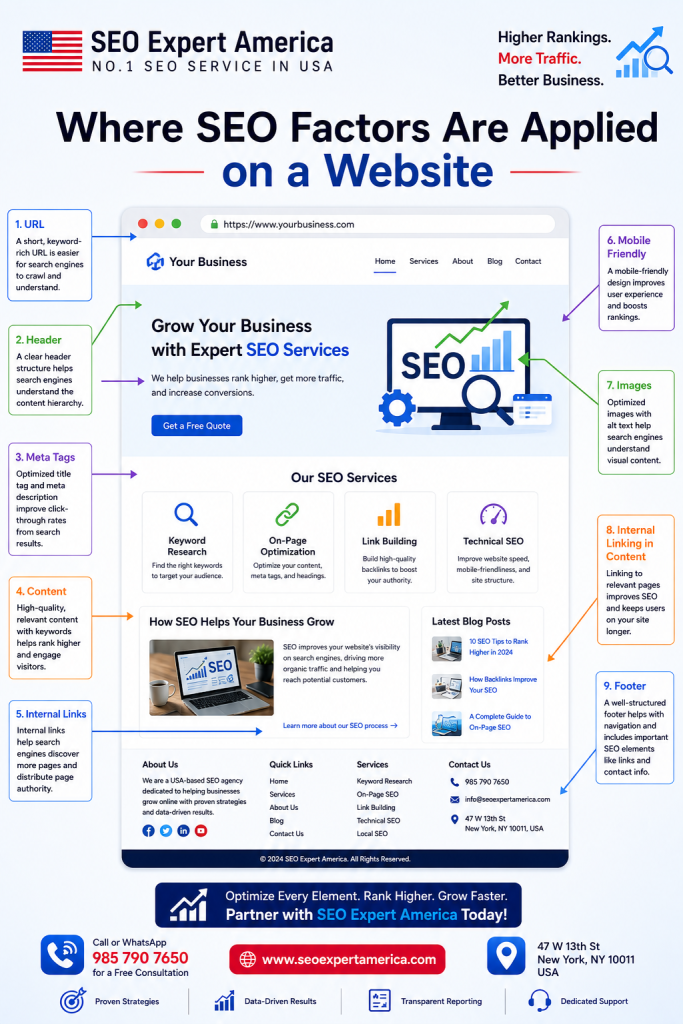
Meta tags help Google understand what your page is about. While they’re not the strongest ranking factor, they significantly impact click-through rates from search results.
What This Means:
- Write compelling title tags (50-60 characters)
- Create unique, descriptive meta descriptions (150-160 characters)
- Use header tags (H1, H2, H3) to structure content
- Include keywords naturally in headings
- Use schema markup to help Google understand your content
Why It Matters:
A compelling title tag and meta description increase click-through rates, sending more traffic to your site. Better CTR signals to Google that your content is relevant and valuable.
6. Website Authority and E-E-A-T
Google has emphasized Expertise, Authoritativeness, and Trustworthiness (E-A-T) as ranking factors, especially for health, finance, and legal content.
What This Means:
- Demonstrate your expertise in your field
- Build author credibility through author bios
- Include credentials and certifications
- Feature testimonials and reviews
- Show signs of legitimacy (About Us page, contact information)
- Build brand authority through thought leadership
Why It Matters:
For competitive niches, especially YMYL (Your Money Your Life) topics, Google prioritizes websites from trusted experts. Building authority takes time but pays dividends.
7. Internal Linking Strategy
Internal links help Google understand your site’s structure and distribute page authority throughout your website.
What This Means:
- Link to related content within your site
- Use descriptive anchor text (not “click here”)
- Create a logical site structure
- Link to high-value pages from multiple places
- Avoid excessive linking on one page
Why It Matters:
Good internal linking helps Google crawl and index your site more efficiently. It also keeps users on your site longer, which signals engagement and relevance.
8. User Engagement Signals
Google tracks how users interact with your website. Pages where users spend time and engage are ranked higher than pages with high bounce rates.
What This Means:
- Reduce bounce rate by improving content quality
- Increase average time on page with engaging content
- Encourage comments and discussions
- Use compelling visuals and multimedia
- Make your content easy to read with short paragraphs and subheadings
Why It Matters:
High engagement signals to Google that your content is satisfying user intent. Pages with low engagement typically see declining rankings over time.
9. Technical SEO and Site Structure
Technical SEO ensures that search engines can crawl, index, and understand your website properly.
What This Means:
- Fix crawl errors in Google Search Console
- Create and submit XML sitemaps
- Optimize your robots.txt file
- Use HTTPS and security certificates
- Fix broken internal and external links
- Ensure proper URL structure
- Use breadcrumb navigation
Why It Matters:
If Google can’t crawl and index your site properly, your content won’t rank no matter how good it is. Technical issues are often overlooked but crucial for SEO success.
10. Content Freshness and Updates
While older content can rank well if it’s comprehensive, regularly updating content signals to Google that your information is current and reliable.
What This Means:
- Update old content with new statistics and information
- Add dates to your content
- Refresh content at least annually
- Add new sections to existing articles
- Monitor content performance and improve underperforming pages
Why It Matters:
For time-sensitive topics, fresh content ranks better. Even for evergreen content, regular updates show that you’re actively maintaining your site and that information is current.
How to Implement These SEO Ranking Factors
Now that you understand what matters, here’s your action plan:
Week 1-2: Quick Wins
- Audit your current content
- Fix meta titles and descriptions
- Check mobile-friendliness
- Test page speed
- Fix broken links
Week 3-4: Foundation Building
- Implement internal linking strategy
- Optimize top-performing pages
- Improve page speed
- Set up Google Search Console
- Create XML sitemap
Month 2: Content Strategy
- Develop a content calendar
- Create 2-3 comprehensive blog posts
- Update old, underperforming content
- Build internal linking strategy
- Start outreach for backlinks
Month 3+: Ongoing Optimization
- Monitor rankings weekly
- Update content regularly
- Build authority through thought leadership
- Acquire quality backlinks
- Track traffic and engagement metrics
Common SEO Mistakes to Avoid
❌ Keyword Stuffing
Don’t overuse keywords. Write naturally for humans first, search engines second.
❌ Thin Content
Don’t publish 300-word articles on competitive topics. Comprehensive content wins.
❌ Buying Backlinks
Avoid link schemes. Focus on creating link-worthy content instead.
❌ Ignoring Mobile Users
With 60%+ mobile traffic, ignoring mobile optimization is career suicide.
❌ Neglecting Technical SEO
Don’t overlook crawlability, indexation, and site structure issues.
Conclusio
SEO success in 2024-2026 requires a holistic approach. It’s not about gaming the system or finding shortcuts—it’s about creating valuable content, building authority, ensuring technical excellence, and providing excellent user experiences.
Start implementing these 10 ranking factors today, and you’ll see improvements in your search visibility within 3-6 months. Remember, SEO is a long-term investment, but the ROI is incredible.
Ready to boost your rankings? Start with high-quality content, optimize your technical SEO, and focus on earning authority. The results will follow.
About the Author
This article was written by SEO Expert America, a leading provider of SEO services and digital marketing solutions. We help businesses increase their online visibility and drive more organic traffic through proven SEO strategies.
Need help with your SEO? Contact us today for a free consultation.
Additional Resources